
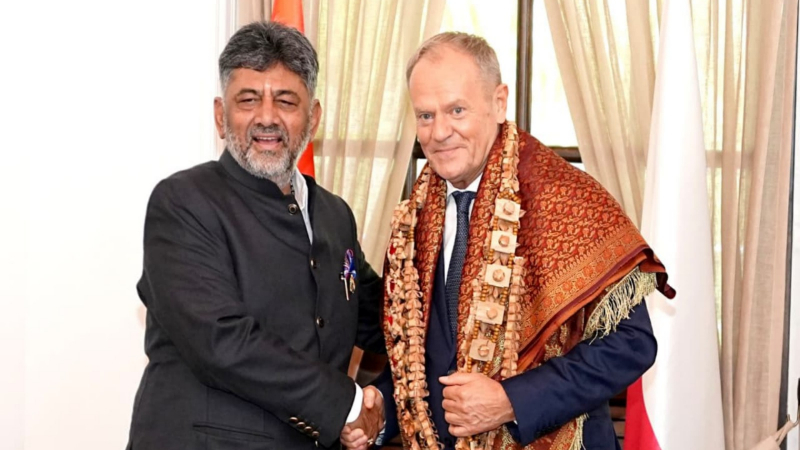
Poland’s Prime Minister Donald Tusk and his delegation touched down at Kempegowda International Airport in Bengaluru on Thursday night to attend a series of scheduled events. The visit follows high-level discussions held earlier in the day between Tusk and Indian Prime Minister Narendra Modi, during which both leaders committed to deepening strategic cooperation, expanding bilateral trade, and establishing robust digital and entrepreneurial connections through a proposed StartUp Bridge.
Tusk was greeted with a bouquet by Krishna Byre Gowda, the Minister for Greater Bengaluru Development and Parliamentary Affairs, representing the Karnataka Government. The welcome ceremony was attended by Chief Secretary Shalini Rajneesh, Secretary of the Department of Personnel and Administrative Reforms KG Jagadish, Bengaluru City Police Commissioner Seemant Kumar Singh, and other senior officials.
Prime Minister Modi shared details of the discussions on social media, stating that they reviewed progress in the Strategic Partnership and agreed to strengthen cooperation in trade, investment, defence, space, nuclear energy, and critical minerals. He added that the leaders also planned to deepen ties in technology, innovation, and people-to-people exchanges, including the establishment of an India-Poland StartUp Bridge and the organization of technology hackathons for youth, alongside expanded collaboration in AI, cybersecurity, education, culture, sports, and tourism.
The Polish Prime Minister announced that Poland-India Partnership Day would be observed annually on March 30, the anniversary of the establishment of diplomatic ties between the two nations. In an official release, Tusk highlighted ambitious plans for cooperation in traditional industries as well as in space, digitalization, and drone sectors. He expressed pride in calling PM Modi a friend and described India as a sign of hope during times of global destabilization and political uncertainty.
Andrzej Domanski, the Polish Minister of Finance and Economy who accompanied the delegation, predicted that commercial exchanges between the two countries would at least double by 2030.